
Connect Four looks simple, but there's real depth beneath the surface. The difference between a casual player and a strong one often comes down to a handful of core principles. This guide covers the most important strategies you need to know.
Control the Center
If you take away one thing from this guide, let it be this: the center column is the most valuable real estate on the board.
Column 4 (the middle) connects to more potential four-in-a-row lines than any other column. A disc placed in the center can contribute to vertical, horizontal, and both diagonal lines. The two adjacent columns (3 and 5) are the next most valuable.
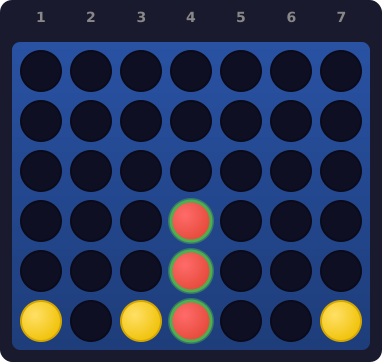
Strong players fight for the center from move one. If you can claim the center and one of its neighbors early, you'll have a dominant position for the rest of the game.
Build Double Threats
The most powerful tactic in Connect Four is the double threat (also called a "fork"). This is when you set up a position where you can win in two different ways on your next move — your opponent can only block one, so you win with the other.
Here's how double threats work:
- You create two separate three-in-a-row sequences that each need one more piece to complete
- These sequences share a key square, or are arranged so that blocking one opens the other
- When your opponent blocks one threat, you complete the other
The classic example is the "Figure 7" trap — a diagonal line of three pieces where the top piece is also part of a horizontal three-in-a-row, forming a shape like the number 7. This pattern is devastatingly effective near the center of the board.
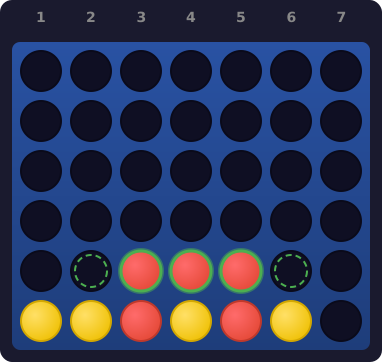
Learning to set up forks — and spotting when your opponent is building one — is the single biggest skill jump most players can make.
Every Move Should Do Two Things
A common mistake is making moves that are purely offensive or purely defensive. Strong players look for moves that accomplish both:
- Block an opponent's threat while extending one of your own lines
- Set up a future winning position while denying your opponent key squares
If your move only does one thing, ask yourself: is there a better square that does two?
Understand Threats and Parity
A threat in Connect Four is any three-in-a-row where the fourth square is empty. Not all threats are equal — their power depends on which row that empty square sits in.
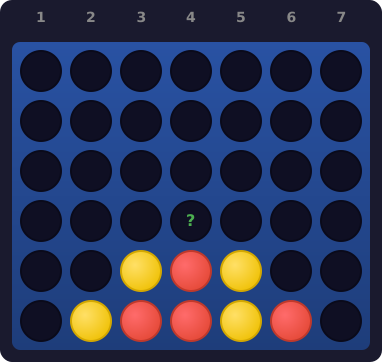
This leads to the odd-even strategy, one of the deeper concepts in Connect Four:
- The first player places discs on moves 1, 3, 5, 7... (odd turns). This means they naturally "claim" squares that get filled on odd moves.
- The second player places on moves 2, 4, 6, 8... (even turns).
- Odd-row threats (rows 1, 3, 5 from the bottom) tend to favor the first player
- Even-row threats (rows 2, 4, 6) tend to favor the second player
If you're the first player, try to build your winning threats on odd rows. If you're second, aim for even rows. This principle becomes especially important in the endgame.
Don't Ignore Vertical Threats
New players often focus on horizontal and diagonal lines while overlooking vertical threats. A stack of three same-colored discs in a column is an immediate danger — if the column isn't blocked on the very next turn, the game is over.
Vertical threats are unique because they have exactly one way to be blocked (playing in that same column). Horizontal and diagonal threats sometimes have multiple defensive options. Use this to your advantage: vertical threats are great for forcing your opponent into specific moves, setting up your next play.
Common Mistakes to Avoid
- Playing the edges too early. Columns 1 and 7 connect to fewer winning lines. Don't waste early moves there.
- Only reacting. If you spend every turn blocking your opponent, you'll never build your own threats. Play proactively.
- Ignoring the board below. Remember that gravity matters — you can't place a piece on row 3 until rows 1 and 2 in that column are filled. Think about which squares will become available as the game progresses.
- Forgetting diagonals. Many games are won and lost on diagonal lines that one player didn't see coming.
Put It into Practice
Strategy only sticks when you apply it. Here are some ways to sharpen your skills:
- Play ranked matches online to test your strategies against real opponents
- Practice against the computer at different difficulty levels to experiment without pressure
- Solve Connect Four puzzles to train your tactical pattern recognition
Want to dive deeper into the opening phase? Check out our opening strategy guide for specific advice on the first few moves, or explore every column in the openings database.
Frequently Asked Questions
What is the best first move in Connect Four?
Column 4, the center column. It is mathematically proven to be the only first move that gives the first player a forced win. Columns 3 and 5 lead to a draw. All other columns lose. See the full breakdown in the openings database.
How do you win at Connect Four every time?
You can't win every time unless you go first and play perfectly from the center column. But you can win more often by controlling the center, building double threats, understanding odd/even threat parity, and thinking two to three moves ahead. Our odd/even threat guide covers the theory behind consistent winning.
What is a double threat in Connect Four?
A double threat is a position where you have two different ways to complete four in a row on your next move. Your opponent can only block one, so you win. Creating double threats is the most reliable way to force a win in Connect Four.
Is Connect Four harder than Tic-Tac-Toe?
Much harder. Tic-Tac-Toe has about 255,168 possible games. Connect Four has over 4.5 trillion possible positions. The depth of strategy, including threat parity, tempo, and positional concepts, makes Connect Four closer to a simplified version of chess than to Tic-Tac-Toe.
How many moves does a Connect Four game usually last?
Most games between experienced players last between 15 and 30 moves. Quick games can end in as few as 7 moves (the minimum needed to get four in a row), while drawn games go the full 42 moves.