
The opening moves in Connect Four matter more than most players realize. Where you place your first few discs sets the foundation for the entire game. Let's look at what the math — and strong players — tell us about the best way to start.
The Center Column Is King
If you're the first player, always start in the center column (column 4). This isn't just a rule of thumb — it's mathematically proven to be the optimal opening.
Why? The center column intersects with more potential four-in-a-row lines than any other position:
- It contributes to multiple horizontal lines across the middle rows
- It anchors vertical connections straight up
- It's part of diagonals going both directions
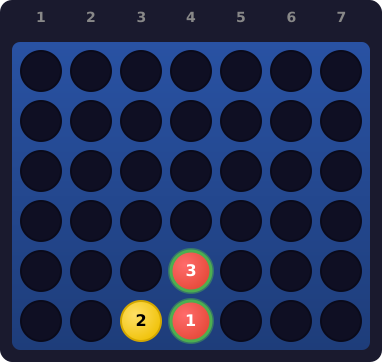
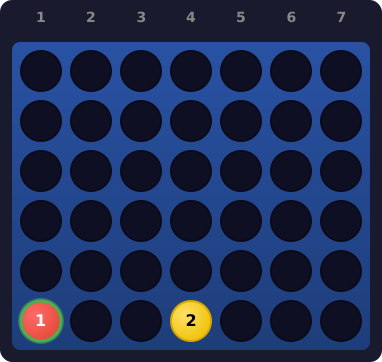
Starting anywhere else as the first player gives up a proven advantage. In fact, starting in the outermost columns (1 or 7) is so weak that the second player can force a win with perfect play.
What the Math Says
Connect Four was solved in 1988. The key finding for openings:
| First Move (Column) | Result with Perfect Play |
|---|---|
| Column 4 (center) | First player wins |
| Columns 3 or 5 | Draw |
| Columns 1, 2, 6, or 7 | Second player wins |
This means your very first move already determines the theoretical outcome of the game. Of course, no human plays perfectly — but starting in the center gives you the best practical chances too.
Responding to the Center Opening
If your opponent starts in the center, your best response is to play in column 3 or column 5 (the columns adjacent to center). This contests control of the central zone and gives you the best drawing chances.
Avoid responding on the edges — it gives the first player too much freedom to dominate the middle of the board.
What happens after the first player plays center?
Here's where it gets counterintuitive. After 4 → 5, the first player's only winning third moves are column 1 or column 2 — the far side of the board. After 4 → 3 (the mirror), the winning moves are column 6 or column 7. In both cases, the first player must play away from the opponent's piece.
Sequences like 4-3-4, 4-5-4, 4-3-3, and 4-5-5 are all draws with perfect play — even though they stay in the center. The first player must leave the "power zone" early to keep the advantage. These winning lines are complex and require very precise follow-up, which is why even strong players often settle for a drawn position by staying central.
The First Few Moves
After the opening drops, the early game follows a few key patterns:
Build central presence. Your first 3-4 moves should focus on columns 3, 4, and 5. This "power zone" gives you maximum flexibility to extend in any direction.
Don't stack too high too fast. Piling pieces in one column early limits your options. Spread your first few moves across 2-3 adjacent central columns.
Watch your opponent's structure. If they're building on one side, consider contesting that side rather than letting them develop freely. But don't chase them to the edges at the expense of center control.
Opening Traps to Know
Even in the early game, there are traps to watch for:
- The vertical stack. If your opponent gets three in a column with room above, you must block immediately. Vertical threats have only one answer.
- The low diagonal setup. Two pieces placed diagonally in the bottom rows can develop into powerful threats. Watch for diagonal patterns early — they're easier to miss than horizontal ones.
- The mirror trap. Some players try to mirror their opponent's moves exactly. This can work for a while, but it fails when the mirroring player runs out of symmetrical options. Don't rely on mirroring as a strategy.
Opening Principles Summary
- First player: Start in column 4. Always.
- Second player: Respond in column 3 or 5.
- Both players: The center zone (columns 3-4-5) is important, but the first player may need to leave it as early as move 3 to maintain a winning advantage.
- Spread out: Don't stack everything in one column.
- Stay alert: Watch for vertical and diagonal setups from your opponent.
Keep Learning
The opening is just the beginning. Once you've established a strong start, you need mid-game tactics to convert your position into a win. Check out our full strategy guide for the principles that matter most.
Ready to practice your openings? Play against the computer where you can experiment freely, or jump into a ranked match to test your skills.
Explore Every Opening
Want to go deeper? The openings database analyzes each first-move column with engine evaluations and example games.