
Puzzles are one of the fastest ways to improve at Connect Four. Each puzzle gives you a board position and asks: what's the best move? The answer is always concrete — there's a right move that leads to a win (or avoids a loss), and you need to find it.
What Are Connect Four Puzzles?
A Connect Four puzzle is a snapshot of a game in progress. It's your turn, and there's a move that either wins immediately or forces a win in the next few moves. Your job is to find that move.
Puzzles come in different difficulty levels:
- Win in 1: Find the column that completes four in a row right now. These train pattern recognition — can you spot the winning line?
- Win in 2-3 moves: The winning move isn't immediately obvious. You need to set up a position where your opponent can't stop you. These train forward thinking.
- Defensive puzzles: Your opponent has a winning threat. Find the only move that prevents it. These train board awareness.
Key Tactical Patterns
Most puzzles revolve around a few recurring patterns. Recognizing them quickly is the core skill.
The Double Threat (Fork)
The most important pattern in Connect Four tactics. You make a move that creates two winning threats simultaneously. Your opponent can only block one per turn, so you win with the other.
Example: You drop a disc between two of your pieces, creating three in a row with both ends open. Your opponent can only block one end — you complete the four on the other side. An open-ended three with room to extend in either direction is unstoppable.
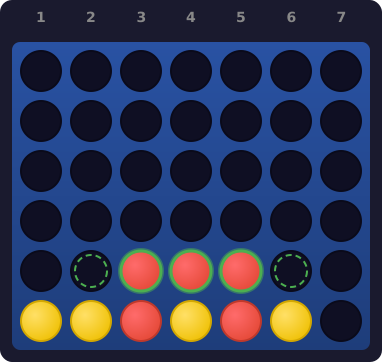
Spotting fork opportunities is what separates strong players from average ones.
Vertical Threats
Three discs stacked in a column with the fourth space open above. This is the simplest and most direct threat — there's exactly one way to block it (play in the same column).
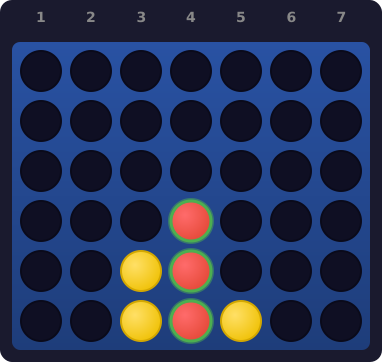
Because vertical threats have only one answer, they're powerful for forcing your opponent's hand. If you can create a vertical threat while also setting up something else, your opponent has to block the vertical — and your secondary plan develops freely.
Forced Sequences
Some puzzles require a sequence of moves, not just one. The idea:
- You make a forcing move (a threat that must be answered)
- Your opponent is forced to respond in a specific column
- That response sets up your next move, which creates another threat
- Repeat until you reach a position where you win
This is the Connect Four version of a "combination" in chess. The key is that each of your moves forces a specific response, so the sequence is predictable.
Gravity Awareness
Unlike many board games, Connect Four has gravity — pieces fall to the bottom. This means:
- You can't place a piece on row 3 until rows 1 and 2 in that column are full
- A threat on a high row isn't dangerous until the squares below it are filled
- Sometimes the right move is to fill a low square that unlocks a future winning position
Strong puzzle solvers always ask: "What happens below this square first?"
How to Approach a Puzzle
When you see a puzzle, try this process:
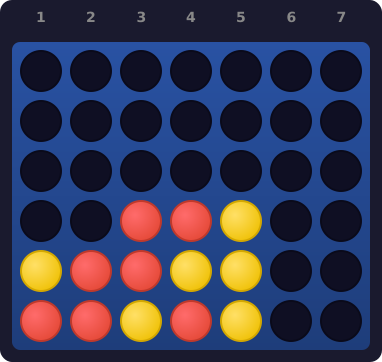
- Scan for immediate wins. Check every column — can you complete four in a row right now? Check horizontal, vertical, and both diagonals.
- Look for opponent threats. If they could win next turn, you need to deal with that first.
- Find double threats. Is there a move that creates two separate three-in-a-rows? That's probably the answer.
- Think one move ahead. If you play here, what does your opponent do? After their response, can you win?
- Consider gravity. Does the move depend on squares below being filled? Is that realistic in this position?
With practice, this process becomes faster. Eventually you'll spot the key patterns almost instantly.
Using Puzzles to Improve
Puzzles are most effective when you treat them as training, not just entertainment:
- Don't guess. Take a moment to think before you choose. Random clicking builds no skill.
- Review wrong answers. When you miss a puzzle, look at the solution and understand why that move works. What pattern did you miss?
- Track your rating. Puzzle ratings show your progress over time. A rising rating means your pattern recognition is improving.
- Do them consistently. A few puzzles daily is better than a marathon session once a month.
Ready to Solve?
Start solving puzzles to put these concepts into practice. Your puzzle rating will track your progress as you improve.
Want to understand the broader principles behind these patterns? Read our strategy guide for the fundamentals, study opening theory for the first few moves, or try playing against the computer to practice in full games.