
Connect Four is a two-player strategy game where the goal is simple: be the first to line up four of your pieces in a row. Whether you call it Connect 4, Four in a Row, or Cuatro en Raya, the rules are the same everywhere.

The Board
Connect Four is played on a vertical grid with 7 columns and 6 rows, giving a total of 42 spaces. The board stands upright, and pieces are dropped in from the top.
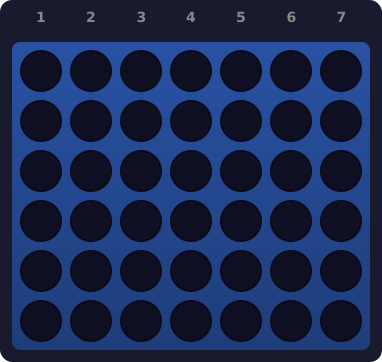
Each player gets 21 discs of their color — traditionally red and yellow, though colors vary.
How to Play
- Players take turns. The first player drops one of their discs into any column from the top.
- Gravity does the work. The disc falls to the lowest available space in that column.
- Alternate turns. The second player then drops their disc, and so on.
- No moving pieces. Once a disc is placed, it stays there for the rest of the game.
That's it — the rules are simple enough to learn in under a minute.
How to Win
A player wins by getting four of their discs in a consecutive line. This line can be:
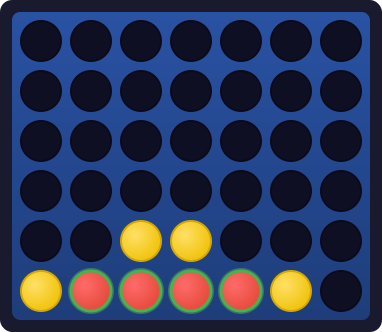
- Horizontal — four in a row across a single row
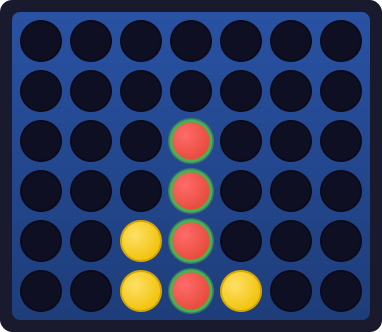
- Vertical — four stacked on top of each other in a column
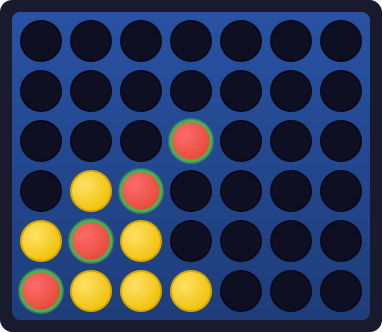
- Diagonal — four in a slanted line, going either direction
The game ends immediately when a player completes a line of four.
Draws
If all 42 spaces on the board are filled and neither player has four in a row, the game is a draw. Draws are less common than in games like chess, but they do happen — especially between experienced players.
Who Goes First?
In casual play, players usually decide who goes first by coin flip or mutual agreement. Going first is actually a significant advantage — mathematically, the first player can always force a win with perfect play if they start in the center column.
In competitive and ranked online play, the first player is typically assigned randomly to keep things fair.
Quick Tips for Beginners
- Aim for the center. The middle column (column 4) gives you the most options for building lines in all directions. Controlling the center is the single most important principle in Connect Four.
- Think ahead. Don't just react to your opponent — try to build your own threats while blocking theirs.
- Watch for diagonals. New players often miss diagonal connections. Scan the board in all four directions before each move.
- Avoid the edges early. The outer columns (1 and 7) offer fewer winning possibilities. Focus on the middle three columns to start.
What's Next?
Now that you know the rules, you're ready to play. But if you want to improve quickly, check out our strategy guide to learn the key principles that separate beginners from strong players.
Ready to put the rules into practice? Play Connect Four online, or practice against the computer to build your skills at your own pace.
Frequently Asked Questions
How many pieces are in Connect Four?
Each player gets 21 discs, for a total of 42 pieces. The board has 42 spaces (7 columns by 6 rows), so a game can last at most 42 moves before ending in a draw.
Can the second player win in Connect Four?
With perfect play from both sides starting from the center column, the first player always wins. But in practice, the second player wins plenty of games. If the first player makes a mistake or starts in a weak column, the second player can take the advantage.
Is Connect Four a solved game?
Yes. James Allen and Victor Allis independently proved in 1988 that the first player can always force a win by starting in the center column. You can read more about this in our solver explainer and test it yourself by playing against the engine.
What size is a Connect Four board?
The standard Connect Four board is 7 columns wide and 6 rows tall, giving 42 total spaces. Some variants use different sizes, but 7x6 is the official and most widely played format.
Can Connect Four end in a draw?
Yes. If all 42 spaces are filled without either player completing four in a row, the game is a draw. Draws happen more often between experienced players who are good at blocking threats.