
Connect Four has been a household staple for over 50 years. But the game's journey — from a toy inventor's workshop to a mathematically solved classic — is more interesting than most people realize.
The Invention (1973)
Connect Four was created by Howard Wexler, a prolific toy and game inventor, in collaboration with his business partner Ned Strongin. Wexler set out to design a game that relied on strategy rather than luck — something accessible enough for children but engaging for adults.
The result was a vertical grid game where pieces dropped by gravity, a mechanic that made the game feel physical and satisfying. It was a simple, original concept that had somehow never been done before.
Milton Bradley and Commercial Release (1974)
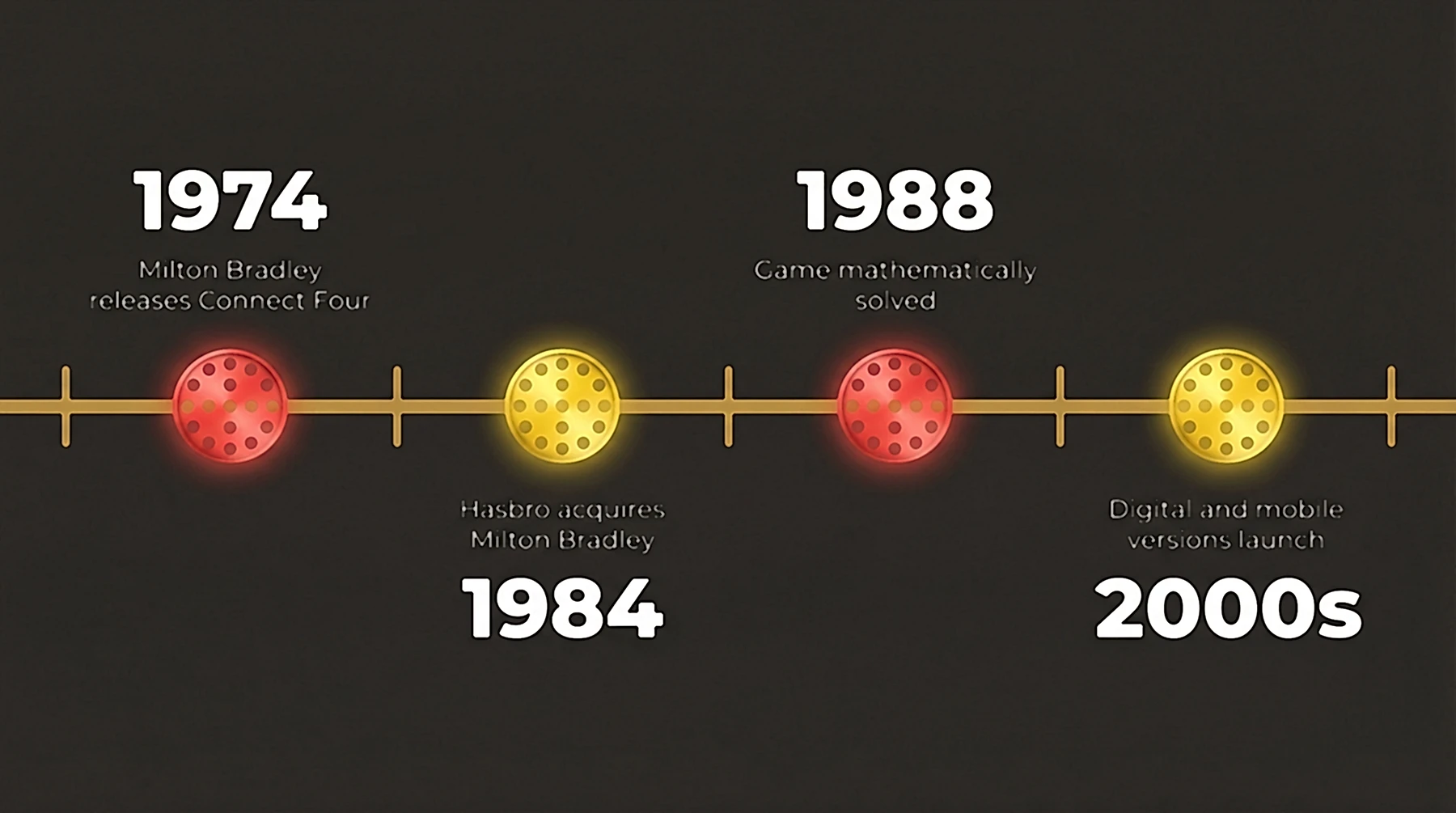
Wexler licensed the game to Milton Bradley, one of the biggest board game companies in America. The game hit shelves in February 1974 under the name "Connect Four."
Initial sales were modest. The game found a following, but it wasn't an instant blockbuster. That changed in 1979, when Milton Bradley launched a television advertising campaign that turned Connect Four into a mainstream hit. The ads showcased the game's quick, dramatic gameplay — and sales took off.
Growing Into a Classic
Through the 1980s and 1990s, Connect Four became one of the best-selling strategy games in the world. Its combination of simplicity, speed, and genuine depth gave it staying power that many competitors lacked.
In 1984, Milton Bradley was acquired by Hasbro, which has continued to produce and market Connect Four ever since. The game has sold millions of copies globally and remains in production today — a remarkable run for any board game.
The Game Gets Solved (1988)
In October 1988, two researchers independently proved that Connect Four is a solved game — meaning a perfect strategy exists that determines the outcome from the very first move.
James Dow Allen published his solution on October 1, 1988. Just fifteen days later, Victor Allis, a computer science student at Vrije Universiteit Amsterdam, published his own independent solution as his master's thesis.
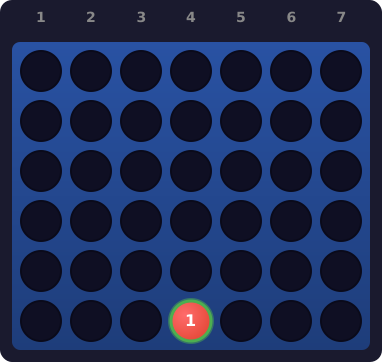
Their key finding: the first player can always force a win with perfect play, but only when starting in the center column. Starting in the columns adjacent to center leads to a draw, and starting on the outer columns actually lets the second player force a win.
Allis's thesis described nine strategic rules and a program called VICTOR that proved the result. The game has approximately 4.5 trillion legal board positions — far too many to brute-force at the time. Both solutions relied on a combination of strategic reasoning and selective computation.
What "Solved" Really Means
Being "solved" doesn't make Connect Four boring or predictable. The game tree is so vast that no human can memorize perfect play. In practice, every game between human players is a genuine contest of skill.
For comparison:
- Tic-Tac-Toe is trivially solved — most adults play it perfectly
- Connect Four is solved, but the strategy is far too complex to memorize
- Checkers was solved in 2007 after 18 years of computation
- Chess and Go remain unsolved and likely will for decades
Connect Four sits in a sweet spot: solved enough to have a known "truth," but complex enough that the truth is practically unreachable for human players.
The Digital Era
The rise of the internet brought Connect Four to a global audience. Online platforms let players find opponents instantly, compete in ranked systems, and track their progress over time.
Modern online Connect Four adds features the physical game never had:
- Matchmaking and ratings for competitive play
- Puzzles for tactical training
- Game analysis to review your moves and learn from mistakes
- AI opponents at various strength levels
These tools have created a new generation of serious Connect Four players who study the game with the same rigor that chess players bring to their craft.
A Game That Endures
More than 50 years after its invention, Connect Four remains one of the most played strategy games in the world. Its genius is in its simplicity: anyone can learn it in a minute, but mastering it takes real effort.
Howard Wexler set out to create a game of pure strategy. By that measure, he succeeded completely.
Want to play? Start a match online or challenge the computer. Curious about the mathematical solution? Read about the Connect Four solver. New to the game? Read our rules guide to get started.