
When you're learning Connect Four, blocking feels like defense. Threatening feels like offense. Most early games are about reacting.
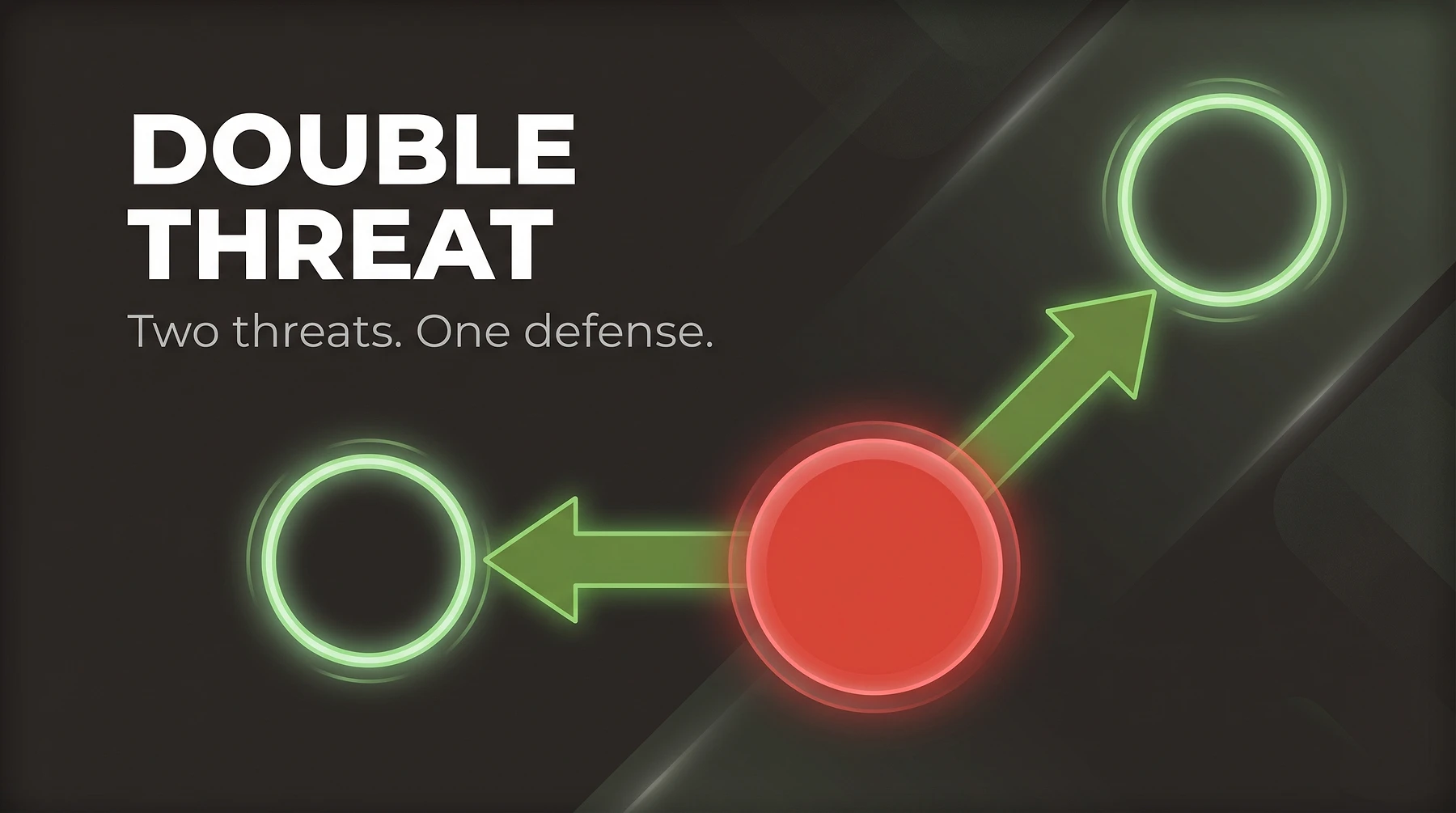
Then you discover the double threat.
With a double threat, you create two ways to win at the same time. Your opponent can only block one. You win.
That's the whole game in four sentences.
What Is a Double Threat?
A double threat (also called a fork) is a position where you have two separate threats — two different ways to complete four in a row — and your opponent cannot block both on the same turn.
Threats can run horizontally, vertically, or diagonally. A double threat usually combines two different directions, or two threats in different columns that can't both be defended in one move.
The key requirement: both threats must be usable on your next turn. A threat your opponent can block in advance doesn't count. A threat buried deep in a nearly full column doesn't count either. Both paths to a win must be live.
Why It's Unstoppable
Your opponent gets one move per turn. One move can block one threat. Two active threats leave one unblocked.
This sounds simple. In practice, it decides most competitive games. You're rarely going to finish Connect Four by building a slow, obvious four-in-a-row while your opponent just blocks. You need a position where stopping you requires more moves than they have.
The double threat is the most direct way to get there.
The Two Types
Horizontal + Diagonal
The most common fork. You set up a horizontal threat — three discs in a row needing one more — and simultaneously a diagonal threat in a different part of the board.
These two threats point in completely different directions. Blocking the horizontal requires covering the gap in the row. Blocking the diagonal requires playing somewhere else entirely. Your opponent can't be in two places at once.
Vertical: Two Heights in One Column
Less obvious but very effective. When a column has your discs stacked with two empty cells above, you sometimes have two threats in the same column — a horizontal threat that completes if you take the lower cell, and a separate threat using the upper cell.
Your opponent can only fill one of those cells per turn. If both empty cells complete separate four-in-a-rows for you, you have a double threat inside a single column. They defend one height; you take the other.
This is why building up a column to threaten from multiple heights is a core attacking technique. A column that gives you two winning cells is a column your opponent can never fully defend.
How to Build One
Double threats don't appear by accident. You build them, usually over 4-8 moves.
The structure looks like this:
Step 1: Establish two developing lines early. Place one disc building toward a row-3 diagonal threat, and another building toward a horizontal in a different zone. Neither is complete yet. Both are growing.
Step 2: Make your opponent react. Advance one threat enough to demand a response. While they block, advance the other.
Step 3: Reach the critical position. They've blocked one line. The second is now one move from completing. They must block again — and while they do, the first line becomes dangerous again.
Step 4: Deliver the fork. Make the single move that puts two threats live simultaneously. If they block one, you take the other next turn.
The zig-zag pattern — alternating between two developing threats and forcing your opponent to keep chasing — is the heart of how forks get built. You're not attacking in a straight line. You're keeping two fires burning while your opponent runs between them.
Recognizing the Setup
In your games, start looking for these positions:
Three in a row with open ends. If you have three discs in a row with an open cell on each end, that's already two potential threats. Your opponent can cover one side. You take the other.
A central disc pointing in multiple directions. Any disc in the center zone of the board can participate in four different four-in-a-rows: horizontal, vertical, and both diagonals. A disc placed in columns 3, 4, or 5 during the early-mid game is a seed for future forks.
One threat one move away, another two moves away. This isn't a fork yet, but it's the setup. If you can complete the near threat while simultaneously bringing the far threat to within one move, the fork becomes real next turn.
Defending Against Double Threats
The best defense is prevention. Once both threats are live, you're beaten.
Stop it before it forms. If you see your opponent building toward a fork, attack instead of defend. Force them to respond to a threat from you. Opponents who are blocking can't be building.
Counter-threaten. A threat that demands an immediate response disrupts your opponent's setup. If your counter-threat is urgent enough, they stop developing their fork entirely. Tactical aggression is often better defense than passive blocking.
Occupy the pivot square. Many forks hinge on a single "connecting" disc — the piece that would make both threats live at once. If you can identify that square and place your own disc there first (or in the same column to block access), you shut down the fork before it arrives.
Play in contested columns. Forks depend on specific cells in specific columns. If you place your discs actively in the columns where the fork is forming, you change what's available. Passive play on the far wings gives your opponent exactly the room they need.
Double Threats and Odd/Even Theory
There's a deeper layer here for players who want to go further.
When you build a double threat, the row numbers matter. From the odd/even threat guide: threats on odd rows (1, 3, 5) favor P1 (Red); threats on even rows (2, 4, 6) favor P2 (Yellow). A fork where both threats sit on odd rows for P1 is the most dangerous kind — it exploits parity in two places simultaneously. P2 can't undercut both.
A fork where one threat lands on an odd row and one on an even row is more complex. P2 might satisfy their own win condition through the even-row path, or undercut one of the two fork lines. These positions require precise calculation.
When planning a fork as P1, aim to build both threats on odd rows. When defending as P2, check whether either arm of your opponent's fork can be undercut by placing an even-row counter-threat in the same column.
The strongest forks are the ones where odd/even parity makes them doubly unstoppable.
Connecting This to Real Games
Double threats appear in almost every high-level Connect Four game. The difference between beginner and intermediate play isn't knowing that forks exist — most players intuit that two threats beat one defense. The difference is building forks consistently rather than stumbling into them by luck.
That comes from a few habits:
Think two threats, not one. Every time you place a disc, ask whether you're developing one line or two. Single-line attacks are easy to stop. Two-line building forces your opponent to choose what to give up.
Leave your pivot square reachable. When setting up a fork, the square that activates both threats must stay accessible. Don't block your own pivot by filling columns in the wrong order. This is a common error in fast time controls — players rush a move and accidentally seal the column they needed.
Recognize when you're in a fork. If your opponent has two live threats, don't waste a move on an irrelevant part of the board. Count the threats. Pick the more immediate one. Then check whether a counter-threat exists that forces them to pause their attack. It often doesn't. When it does, that's your out.
Practice
Forks are learnable. You can get significantly better at building and spotting them in a short period of focused play.
The fastest way: solve puzzles. A large share of Connect Four puzzles are solved by finding a double threat. You'll develop pattern recognition for the "two threats from one move" structure by working through 20 or 30 positions. The geometry starts to feel natural.
After puzzles, play the engine with your attention on structure, not just outcome. The engine builds fork-based attacks naturally and often sets up double threats several moves in advance. Watch how a single disc placement creates two developing lines. That's the habit you're building.
After each game, review it. The move labels show where fork attempts succeeded, stalled, or missed the best continuation. Reviewing a loss where you got forked will often reveal the exact move where your opponent locked in their two-threat structure.
Two threats. One defense. That's how games end.
Once you can build double threats reliably, you stop waiting for mistakes. You start creating positions where correct play still isn't enough.
More on the concepts that make forks work: the strategy guide covers the mid-game principles that create fork opportunities, and the odd/even threat guide explains which rows make a double threat truly unstoppable.