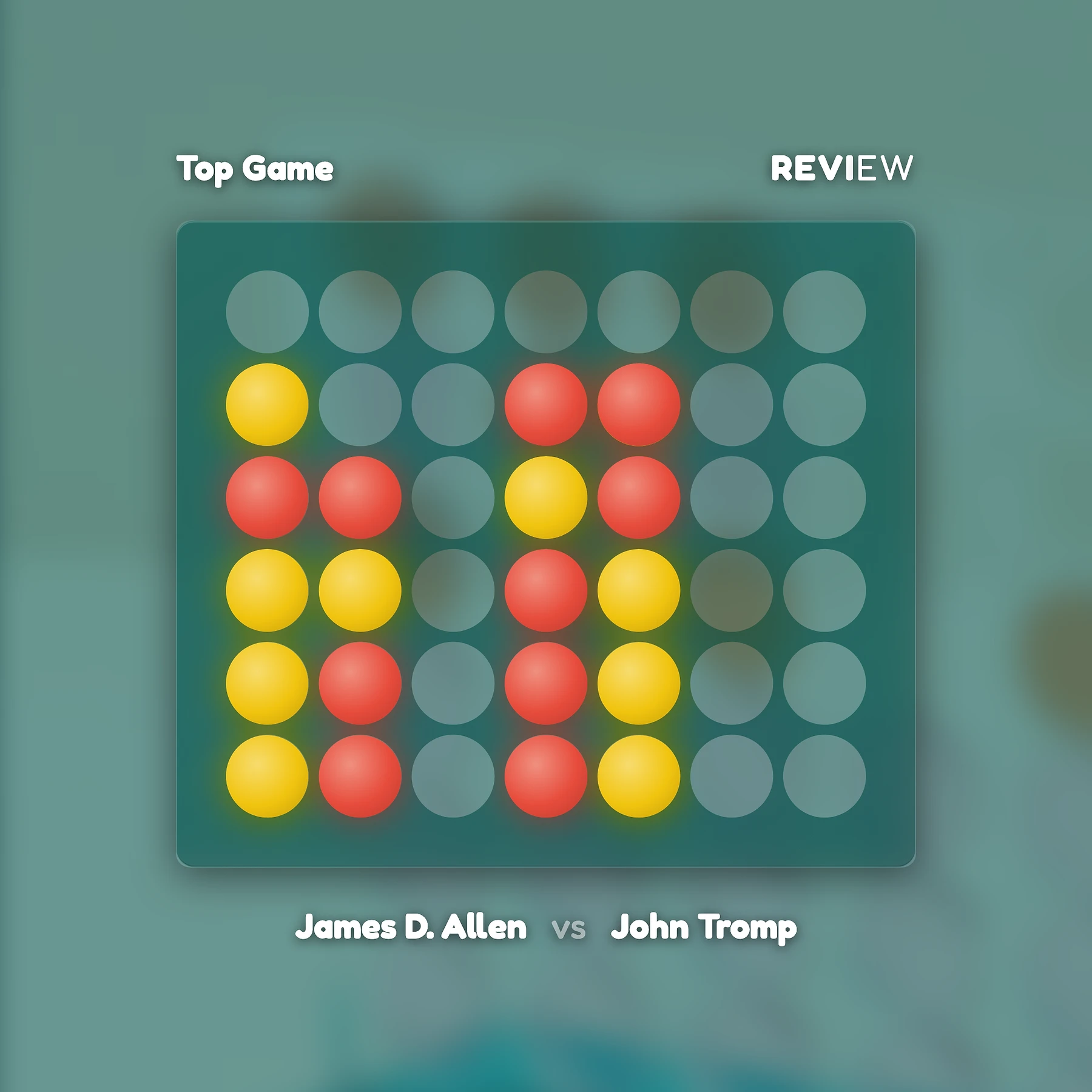
In 1995, James D. Allen and John Tromp played a six-game Connect Four match — a historic match between two people who had independently contributed to solving the game. The series ended 3-3. Game 1 was a tense battle. Game 2 was not. Allen seized central territory early, punished a weak reply, and never let go.
Here is a complete breakdown of the game.
James D. AllenvsJohn Tromp
Move 1/19
Use arrows to step through
The Opening: D1 e1 B1 e2
Allen opens with D1 — the center column, the strongest first move in Connect Four. Tromp answers with e1, taking the adjacent column. A standard, solid reply.
Allen's second move is B1, stepping away from the center to begin building on the left side of the board. This is where the game turns. Tromp responds with e2 — stacking a second disc in column E.
This is a weak play. By doubling up in column E instead of contesting Allen's expansion, Tromp surrenders the left side of the board entirely. Strong players fight for territory across the board. Letting your opponent develop an entire flank unopposed is a recipe for trouble.
After move 4 (e2) — Tromp's weak response
Allen Builds Unchallenged: B2 b3 D2 e3
With Tromp focused on column E, Allen plays B2, stacking column B and beginning to form vertical and diagonal connections. Tromp answers with b3 — finally entering column B, but only as a reaction. Allen has already established a presence there.
Allen returns to the center with D2, building a two-high stack in the most valuable column on the board. Tromp plays e3, continuing to build column E. After seven moves, the picture is clear: Allen owns the center and the left. Tromp has a tall column E and not much else.
The Threat Configuration: E4 a1 D3 d4 B4
Allen drops E4, inserting a disc into Tromp's own column. This move does double duty — it blocks Tromp's vertical progress in E while connecting Allen's own pieces diagonally.
Tromp plays a1, starting column A on the far left. Allen responds with D3, building a three-high center column that radiates influence in every direction. Tromp plays d4, capping Allen's column to prevent a fourth — a necessary defensive move.
Then comes B4. This is the key structural move of the game. Allen places his disc on top of column B, and the position suddenly reveals a threat configuration spanning A5, C3, and C2. Allen doesn't need to complete the threat immediately. The mere existence of the configuration forces Tromp to spend moves dealing with it — and those are moves Tromp can't spend on his own plans.
After move 13 (B4) — Allen's threat configuration
The Tempo Battle: a2 D5 a3 A4 a5
Tromp recognizes the danger on the left side and plays a2, extending up column A. Allen ignores this entirely and plays D5 — the fifth row of the center column. Allen now holds D1, D2, D3, and D5. That is commanding central presence.
Tromp pushes a3, continuing to climb column A in an attempt to neutralize the threat at A5. Allen responds with A4, entering the column himself. Tromp plays a5, finally reaching the critical square.
The threat is technically destroyed. But look at what it cost. Tromp spent three consecutive moves — a2, a3, a5 — pushing up a single edge column. In a game where tempo and initiative are everything, spending three moves on defense while your opponent builds elsewhere is devastating.
The J-Configuration and Resignation: E5
While Tromp was busy on column A, Allen was building something far more dangerous. With E5, Allen completes the final piece of the puzzle.
Look at the stones: D3, D5, E4, E5. These four positions form what's known as a J-configuration — a pattern where the connected discs create an unavoidable winning threat. Specifically, Allen has a forced win at F5. The discs trace a diagonal and adjacent connection that cannot be blocked without creating another winning line.
Tromp sees it. He could play G1, attempting to undercut F5 by building from the bottom of column F. But Allen would simply take B5, creating yet another winning threat. There is no defense.
Tromp resigns.
What This Game Teaches
Game 2 illustrates three fundamental Connect Four principles:
Contest every part of the board. Tromp's 2..e2 — stacking column E instead of fighting for the left side — gave Allen free development. In Connect Four, uncontested territory becomes winning territory.
Threats cost your opponent time. Allen's B4 threat configuration didn't win directly, but it forced Tromp to spend three moves on the A-column. That tempo advantage let Allen build the decisive J-configuration in the center.
Central control wins games. Allen held D1 through D5 and connected through E4-E5. The center column connects to more winning lines than any other column on the board. Owning it is often the difference between winning and losing.
The Series Continues
After Game 2, Allen leads 2-0. His positional style — claiming territory and building threats that force defensive responses — has proven dominant so far. But Tromp is a world-class player who co-solved the game. The series is far from over.
We use essential cookies for authentication and site functionality. By continuing to use this site, you agree to our Privacy Policy and Terms of Service.