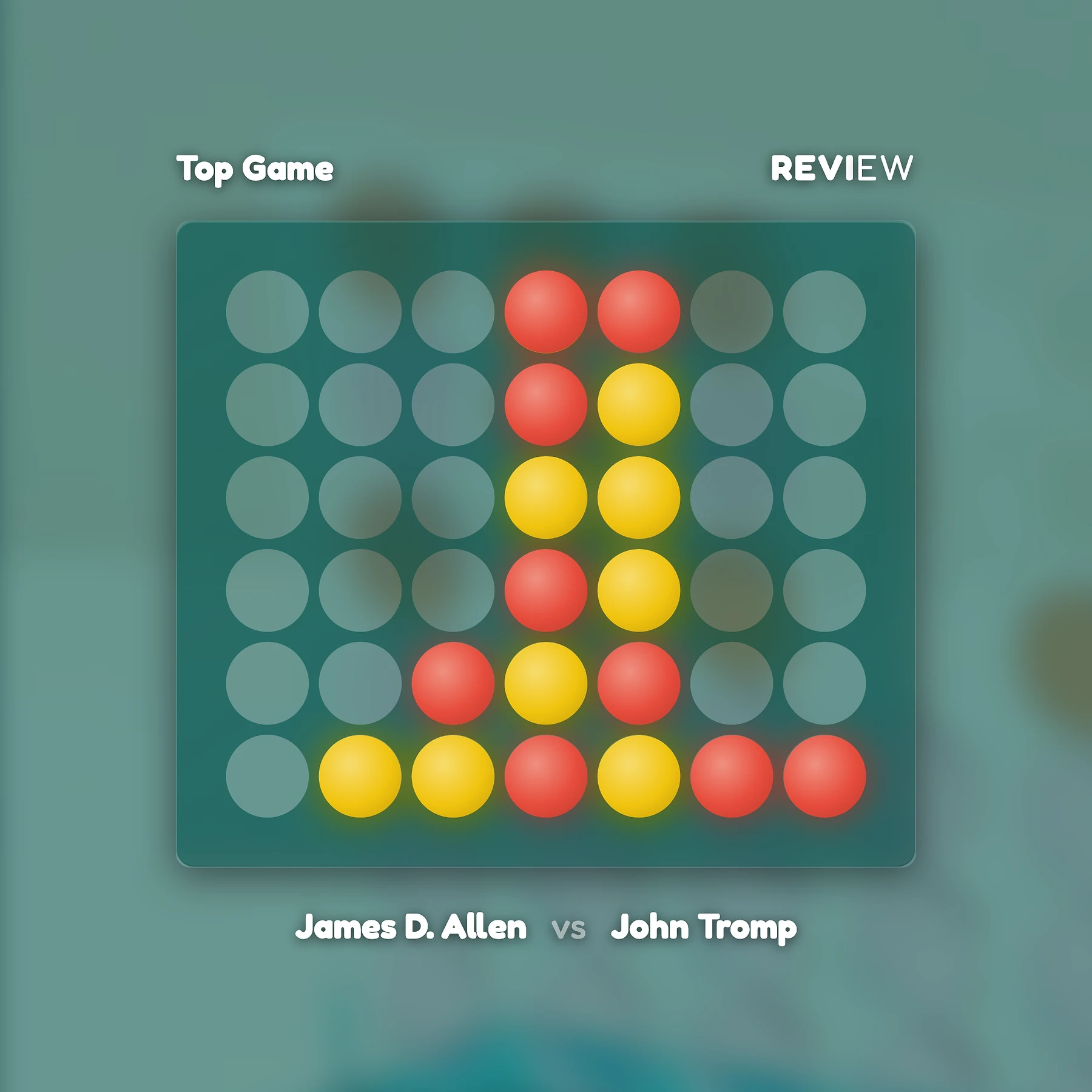
In 1995, two of the most important figures in Connect Four history sat down to play each other. James D. Allen had solved Connect Four on October 1, 1988, proving that the first player can always force a win with perfect play. John Tromp had gone further — he strongly solved the game in 1995, computing the exact value of every reachable board position.
These two didn't just understand Connect Four. They had mapped the entire game.
They played a six-game match — a historic Connect Four match between the game's two solvers. The final score: 3-3, no draws. Every game ended decisively. This is the analysis of Game 1.
James D. AllenvsJohn Tromp
Move 1/17
Use arrows to step through
The Opening: Center Control
1. D1 — Allen opens in the center column. This is the only first move that guarantees a win with perfect play. Every solved line begins here.
2. ...c1 — Tromp responds in column C, the adjacent column. A standard, solid reply that fights for central influence without conceding the middle.
3. G1 — Allen chooses a less popular but still winning continuation. After D1 c1, the standard line is D1 c1 F1 — it has more lines to memorize, but each individual line is typically easier to navigate. D1 c1 G1 is the opposite: fewer lines to know, but each one is harder on average. Even so-called "perfect players" — those who can always win as Player 1 in normal play — will slip up here if they aren't familiar with the opening. Whether to play F1 or G1 at this point is honestly personal preference, though for players starting out, D1 c1 F1 is the safer recommendation since each line is more forgiving.
4. ...d2 — Tromp stacks on top of Allen's center piece, claiming the second row in column D. A natural move: it blocks Allen's vertical development in the most important column and stakes a claim in the center.
Building the J-Configuration
5. D3 — Allen takes column D back, stacking on top of Tromp's piece. Three of the first five moves have landed in the center column. Allen now has pieces on D1 and D3 — the odd rows. This is the beginning of the J-configuration, a vertical threat pattern built on alternating pieces in a single column.
6. ...d4 — Tromp continues to contest column D. The column is now four pieces tall.
7. F1 — This is the only correct move. Playing D5 here actually loses. This is a perfect example of what makes the D1 c1 G1 opening so demanding — many positions along this line have exactly one path that wins for Player 1, and anything else hands the advantage to Player 2.
8. ...e1 — Tromp takes column E on the bottom row. A reasonable developing move.
9. E2 — Allen stacks on E. Two Allen pieces now sit in column E.
10. ...e3 — Tromp blocks Allen's J-configuration here to prevent an easy right-side win. Without this move, Allen's structure would develop unchallenged on that side of the board.
The Middle Game: Threats Take Shape
11. C2 — Allen builds in column C. His pieces are spreading across the lower rows with clear diagonal potential. If you look at the board, Allen has pieces on D1, G1, F1, E2, D3, and C2 — forming lines in multiple directions.
12. ...e4 — Tromp stacks column E to four pieces. Both players are building tall in the center while laying groundwork for horizontal and diagonal threats.
13. D5 — Another forced move for Allen. This plays a primarily defensive role: it prevents a Player 2 counter-odd threat on the right side, which would cancel out the odd threat formed by the J-configuration on the left side, leading to a draw. Allen's J-configuration is not formed explicitly yet, but it's essentially guaranteed — Allen has C4 as a major threat, from which he can always take C3 and C5, both critical cells for his win here.
After move 16 (b1) — Tromp's standard J-configuration defense
We use essential cookies for authentication and site functionality. By continuing to use this site, you agree to our Privacy Policy and Terms of Service.