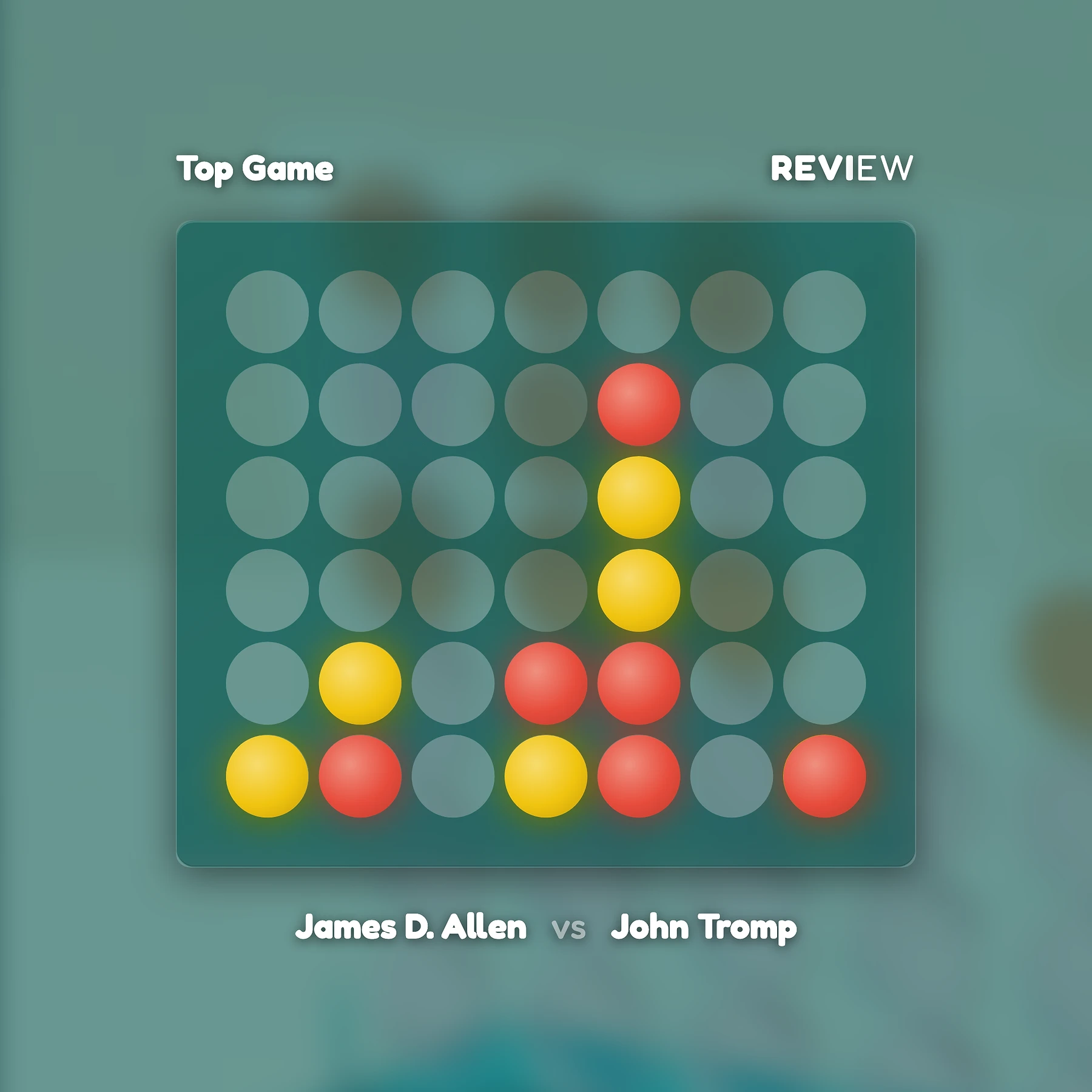
After four decisive games, the Allen vs Tromp match was dead level at 2-2. Allen had taken the first two games, proving that his understanding of first-player theory was world-class. Then Tromp struck back, winning Games 3 and 4 to pull even. Game 5 was the pivot point — the winner would take a lead into the final game with everything on the line.
Allen had the red pieces and moved first. In Connect Four, the first player holds a theoretical advantage. But theory only matters if you don't make mistakes.
James D. AllenvsJohn Tromp
Move 1/16
Use arrows to step through
The Opening: A Quiet Build
1. B1 — Allen opens in column B, stepping away from the center. This is a less common first move — column D is the only opening that guarantees a forced win with perfect play. By choosing B, Allen is steering the game toward less explored territory, perhaps hoping to catch Tromp off-book.
2. ...b2 — Tromp stacks directly on top, claiming the second row in column B. An assertive reply — rather than grabbing his own foothold elsewhere, Tromp immediately contests Allen's column.
3. E1 — Allen places in column E, establishing a second base on the bottom row. His two pieces on B1 and E1 are spaced apart, keeping his options open for horizontal and diagonal development.
4. ...d1 — Tromp takes the center bottom. Column D is the most valuable real estate on the board, and Tromp secures it early.
5. E2 — Allen stacks column E. This is the move that looked natural but turned out to be the game's original sin. The correct plays were D2 or b3 — moves that would have maintained competitive pressure in the center or built on Allen's existing column B structure. Allen didn't realize it at the time, but E2 gives Tromp a path to a forced win with precise play.
The Middle Game: Tromp Sets the Trap
6. ...e3 — Tromp plays on top of Allen's E2. Column E is now three pieces tall and contested. Tromp is building vertically while keeping his options open.
7. D2 — Allen takes the center column, second row. A developing move, but he's a step behind where he needed to be — D2 on move 5 would have been stronger than E2.
8. ...e4 — Tromp claims the fourth row in column E. He now has three pieces in this column (e3, e4 stacked on Allen's E2), creating vertical pressure.
9. E5 — Allen caps the column E battle by taking the fifth row. The column is now nearly full.
10. ...a1 — This is the move that separates experts from everyone else. Tromp drops a piece in the far corner — column A, bottom row. It looks passive. It looks like a throwaway. It is neither.
Tromp's a1 is subtle and cunning, setting a trap. By placing in the corner, Tromp creates latent diagonal potential running from a1 upward through the board. More importantly, it forces Allen to respond carefully. The wrong reply here hands Tromp a forced win.
The Blunder
11. G1 — This is the moment the game turned. Allen plays in column G, the opposite corner. It looks symmetrical, it looks reasonable — but it is a blunder.
Allen needed to play B3 here. After B3, Allen would have maintained a defensible position, answering Tromp's corner threat by building on his own column B structure. B3 blocks critical diagonal lines and keeps Allen in the game.
Instead, G1 gives Tromp everything he needs. After this move, Tromp has a forced win — not just an advantage, not just a better position, but a mathematically determined sequence that leads to victory regardless of how Allen plays.
After move 11 (G1) — Allen needed B3 here
12. ...d3 — Tromp begins the execution. D3 stacks column D and starts building the forcing sequence. Every move from here forward is calculated.
13. D4 — Allen takes the fourth row in column D, trying to block Tromp's vertical development. But Tromp isn't building a simple four-in-a-row. He's constructing something far more dangerous.
14. ...b3 — Tromp takes the B3 square that Allen should have claimed on move 11. This is the square that would have saved Allen's game. Now it's Tromp's, and it anchors a diagonal threat running through the center of the board.
15. B4 — Allen stacks column B. He's responding to threats, but Tromp is driving.
16. ...g2 — Tromp completes the construction. With g2, Tromp establishes the triple threat at c2-c3-f5. Allen cannot block all three.
Final position — Tromp's triple threat is unstoppable
Allen resigns. The position is lost.
What Is a Triple Threat?
A triple threat is one of Connect Four's most devastating tactical patterns. It occurs when a player creates three separate threats to complete four-in-a-row, and the opponent can only block one threat per turn. Since you can only drop one piece at a time, two threats will remain open. On the next turn, the attacking player completes one of the unblocked lines and wins.
In this game, Tromp's triple threat at c2, c3, and f5 meant that Allen would need to simultaneously fill three different squares to survive. That's impossible. The game is over the moment the triple threat is established.
Triple threats don't appear out of nowhere. They require precise setup — a sequence of forcing moves where each move either creates a direct threat or positions a piece that contributes to the final pattern. Tromp's play from move 10 onward is a masterclass in this kind of construction. Every piece he placed served double duty: defending against Allen's ideas while building toward the triple threat.
Why G1 Lost the Game
The natural question is: how does one move in the corner lose a game between two experts? The answer lies in threat parity and diagonal control.
When Allen played G1 instead of B3, he left the b3 square open for Tromp. That square was a critical junction — it connected Tromp's diagonal lines running from the a1 corner through the center of the board. Without B3, Allen had no way to interrupt Tromp's forcing sequence. Every subsequent move by Allen was forced — he was responding to Tromp's threats rather than creating his own.
The deeper lesson is that Allen's opening choice of E2 on move 5 (instead of D2 or b3) had already narrowed the path. By the time move 11 arrived, B3 was the only move that held the position together. Allen's choice of G1 — playing in the opposite corner rather than the critical defensive square — was the kind of mistake that only matters at the highest level, where the margins between winning and losing are a single square.
The Match Situation
With this win, Tromp takes a 3-2 lead heading into the final game. Allen, who had led 2-0 after the first two games, now needs to win Game 6 just to level the match. The pressure has shifted entirely.
We use essential cookies for authentication and site functionality. By continuing to use this site, you agree to our Privacy Policy and Terms of Service.