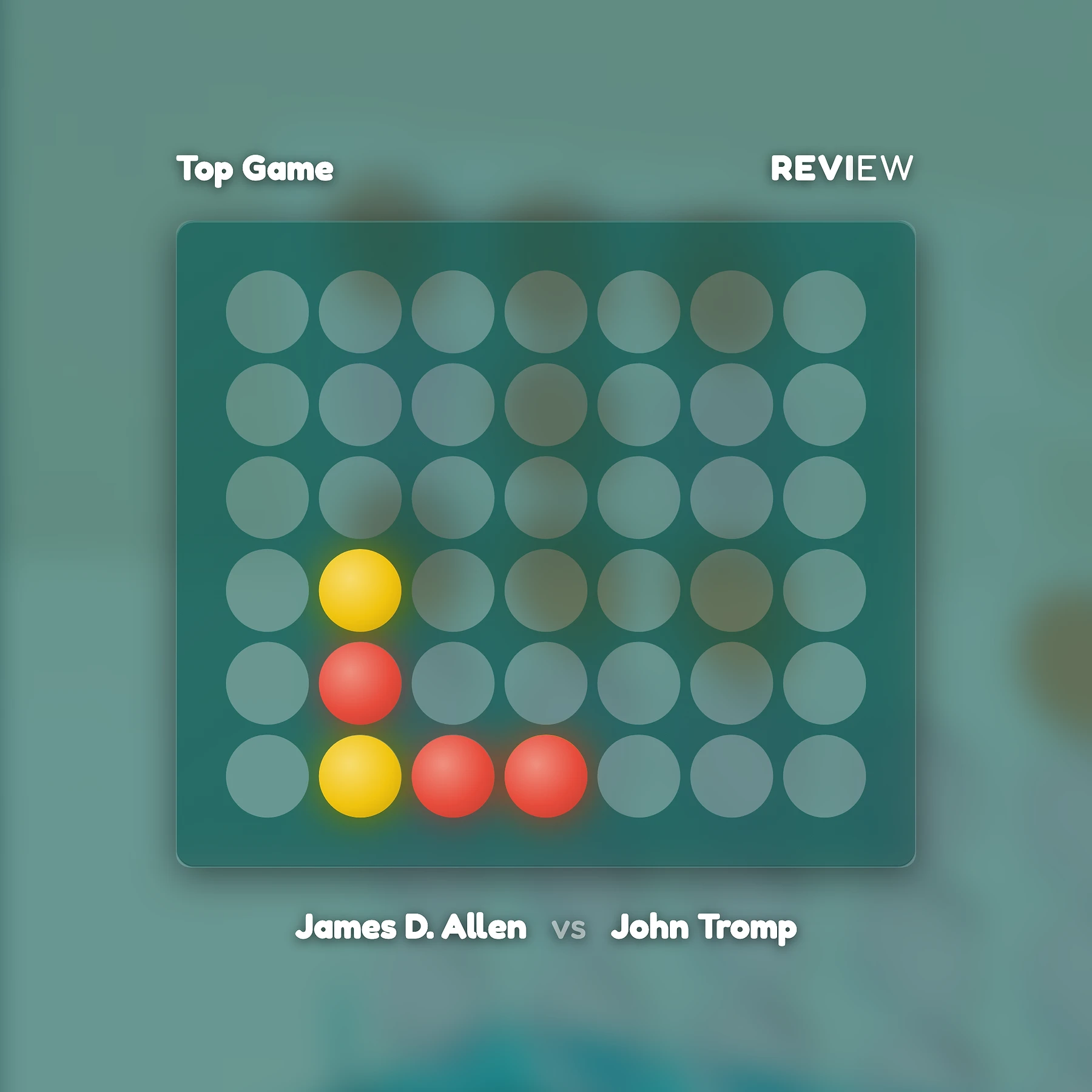
Heading into Game 4, James D. Allen held a 2-1 lead over John Tromp in their 1995 match. Tromp needed a win to level the series. Instead, Tromp delivered one of the most instructive games in competitive Connect Four history — a slow, methodical positional squeeze that left Allen with no good options by move 19.
This game is worth studying not for its fireworks, but for what it teaches about patience. Tromp won without a spectacular combination. He won by making sure Allen never had room to breathe.
James D. AllenvsJohn Tromp
Move 1/19
Use arrows to step through
The Opening: Familiar Ground
The game opened with Allen dropping into column C and Tromp responding in column B — a standard asymmetric setup. The first four moves (C1 b1 B2 b3) established positions on the left side of the board, with both players building stacks in columns B and C.
At this point, the game was roughly balanced. Both sides had begun developing toward the center, and the real strategic decisions were just ahead.
Move 5: Allen's Mistake
Allen played 5.D1 — placing a piece at the bottom of column D. On the surface, this looks reasonable. Column D is central, and claiming the bottom row gives a foundation for vertical development.
But D1 was a mistake. Allen should have played B4 or E1 instead. The problem with D1 is subtle: it commits to a central ground-floor presence without establishing the lateral connections Allen needed. B4 would have extended his column B stack into a more threatening position, while E1 would have started building influence on the right side of the board.
After move 5 (D1) — Allen's mistake
Tromp could have punished this directly — had Allen played 5.F1, for example, Tromp could have answered with e1 and won outright. The position was already starting to tilt in Tromp's favor, even if the board didn't look dangerous yet.
This is the nature of positional play in Connect Four. The losing move doesn't always look like a losing move. Sometimes it simply gives your opponent a fraction more control, and that fraction compounds.
The Mutual Errors: Moves 8 and 9
The game then entered a curious phase where both players made errors that effectively canceled each other out.
After Allen played 7.B4 and Tromp responded with e1 (move 8), Tromp's choice of e1 was actually an error. The stronger continuation would have been the sequence D4-d5-A1-d6, which would have built a more direct winning path. By playing e1, Tromp gave Allen an opportunity to regain balance.
But Allen failed to capitalize. His reply of 9.E2 was itself an error, handing the advantage right back. The mistakes offset each other, and the position returned to something close to what proper play from both sides would have produced.
This sequence is instructive for a different reason: even at the highest level, Connect Four players make mistakes. What separates strong players from weak ones is not the absence of errors — it's what happens afterward. Tromp, despite his imprecise eighth move, maintained his structural advantages and never let Allen exploit the lapse.
The Squeeze Tightens
From move 10 onward, Tromp began executing the positional squeeze that gives this game its character.
The middle section of the game saw both players maneuvering in columns B, C, and D. Tromp played d3 (move 10) and later c2 (move 12), reinforcing his influence in the center. Allen responded with D4 (move 11) and C3 (move 13), but his pieces were reactive rather than proactive. He was responding to Tromp's threats rather than creating his own.
Move 14 saw Allen drop a piece to a1 — all the way to the far left edge. This retreat to column A spoke volumes about the state of the board. Allen was running out of constructive options in the columns that mattered.
Tromp continued building with D5 (move 15) and then d6 (move 16), stacking column D to its upper reaches. Allen played B5 (move 17), still trying to create something in column B, but Tromp's control of the center and right side of the board made it impossible for Allen to construct a viable four-in-a-row.
The Concept: What is a Positional Squeeze?
A positional squeeze is not a single tactic — it's a strategic pattern. Instead of winning through a direct combination or a flashy double threat, the squeezing player gradually restricts the opponent's options until there are no good moves left.
In Connect Four, this typically works by controlling key columns and rows so that every placement the opponent makes either helps the squeezer or does nothing useful. The squeezed player finds that building in one direction is blocked, building in another creates threats for the opponent to exploit, and passivity leads to a slow death.
Tromp's squeeze in this game operated through column dominance. By controlling the stacks in columns B, C, and D, he ensured that Allen's pieces couldn't form connections without also enabling Tromp's own threats. Allen was like a player trapped in a shrinking room — every move brought the walls a little closer.
For a deeper look at these strategic concepts, see our strategy guide, which covers center control, double threats, and the principles that make positions like Tromp's so effective.
Move 19: The Resignation
Tromp's 19th move, b6 — placing a piece at the top of column B — completed the squeeze. With this move, Tromp established a winning configuration that Allen could not prevent.
Final position — Tromp wins by resignation
Allen resigned. There was no combination available, no defensive resource, no trick. Tromp had simply accumulated too many small advantages, and the position had become hopeless.
Nineteen moves is a short game by competitive standards. But this was not a quick tactical kill — it was a slow, patient constriction that happened to reach its conclusion early because Allen's initial mistake gave Tromp the raw material he needed to execute the squeeze efficiently.
Match Implications
With this victory, Tromp leveled the match at 2-2 with two games remaining. After trailing 0-2, Tromp had won back-to-back games to pull even — a testament to his resilience and adaptability.
Game 4 was a statement: Tromp could win not just through calculation, but through pure positional pressure. That versatility made him an extraordinarily difficult opponent, and the momentum had shifted decisively.
This game offers three concrete lessons for improving players:
Opening accuracy matters. Allen's D1 on move 5 didn't lose immediately, but it set in motion a chain of small disadvantages that proved fatal. Study your openings carefully — the first moves carry disproportionate weight.
Errors can cancel out, but structure doesn't lie. Both players made mistakes in moves 8 and 9, yet Tromp maintained his structural edge. Focus on building sound positions, not just avoiding mistakes.
Patience wins games. Tromp didn't need a brilliant combination. He needed steady, accurate play that slowly removed Allen's options. This approach is replicable and powerful at every level of play.
We use essential cookies for authentication and site functionality. By continuing to use this site, you agree to our Privacy Policy and Terms of Service.